Quantic X-Microwave

Analog Devices RF and microwave components are available as drop-in X-MWblocks®
from Quantic X-Microwave.

Get the X-MWblock® drop-in module for this part.

ADGM1004

RECOMMENDED FOR NEW DESIGNS

0 Hz/DC to 13 GHz, 2.5 kV HBM ESD, SP4T, MEMS Switch with Integrated Driver

Viewing:

Overview

  • Fully operational down to 0 Hz/dc
    • On resistance: 2.9 Ω (maximum)
    • Off leakage: 0.5 nA (maximum)
  • −3 dB bandwidth
    • 10.8 GHz (typical) for RF1, RF4
    • 13 GHz (typical) for RF2, RF3
  • RF performance characteristics
    • Insertion loss: 0.45 dB (typical) at 2.5 GHz
    • Isolation: 24 dB (typical) at 2.5 GHz
    • IP3: 67 dBm (typical)
    • RF input power: 32 dBm (maximum)
  • Actuation lifetime: 1 billion cycles (minimum)
    • Hermetically sealed switch contacts
    • On switching time: 75 µs (maximum)
  • ESD HBM rating
    • 5 kV for RF1 to RF4 and RFC pins
    • 2.5 kV for all other pins
  • Integrated driver removes the need for an external driver
    • Supply voltage: 3.0 V to 3.6 V
    • CMOS/LVTTL compatible
    • Parallel and SPI Interface
    • Independently controllable switches
  • Switch is in an open state with no power supply present
  • Requirement to avoid floating nodes on all RFx pins
  • 5 mm × 4 mm × 1.45 mm, 24-lead LFCSP
  • Operating temperature range: 0°C to 85°C

The ADGM1004 is a wideband, single-pole, four-throw (SP4T) switch fabricated using Analog Devices, Inc., microelectro-mechanical system (MEMS) switch technology. This technology enables a small form factor, wide RF bandwidth, highly linear, low insertion loss switch that is operational from 0 Hz/dc to 13 GHz, making it an ideal solution for a wide range of RF and precision equipment switching needs.

An integrated driver chip generates a high voltage to electrostatically actuate switch that can be controlled by a parallel interface and a serial peripheral interface (SPI). All four switches are independently controllable.

The device is packaged in a 24-lead, 5 mm × 4 mm × 1.45 mm, lead frame chip-scale package (LFCSP).

To ensure optimum operation of the ADGM1004, follow the Critical Operational Requirements section exactly.

The on resistance (RON) performance of the ADGM1004 is affected by part to part variation, channel to channel variation, cycle actuations, settling time post turn on, bias voltage, and temperature changes.

Note that throughout this data sheet, multifunction pins, such as IN1/SDI, are referred to either by the entire pin name or by a single function of the pin, for example, SDI, when only that function is relevant.

Applications

  • Relay replacements
  • Automatic test equipment (ATE): RF, digital, and mixed signals
  • Load and probe boards: RF, digital, and mixed signals
  • RF test instrumentation
  • Reconfigurable filters and attenuators
  • High performance RF switching

ADGM1004
0 Hz/DC to 13 GHz, 2.5 kV HBM ESD, SP4T, MEMS Switch with Integrated Driver
ADGM1004 Functional Block Diagram ADGM1004 Pin Configuration
Add to myAnalog

Add product to the Products section of myAnalog (to receive notifications), to an existing project or to a new project.

Create New Project
Ask a Question

Documentation

Learn More
Add to myAnalog

Add media to the Resources section of myAnalog, to an existing project or to a new project.

Create New Project

Software Resources

Can't find the software or driver you need?

Request a Driver/Software

Tools & Simulations


Evaluation Kits

eval board
EVAL-ADGM1004SDZ

ADGM1004SDZ Evaluation Board

Features and Benefits

  • Single supply voltage 3.3 V
  • Wide frequency range
  • SMA connectors for RF signals
  • SMB connectors for switch control signals
  • On-board calibration transmission line for analyzer calibration

Product Details

The EVAL-ADGM1004SDZ evaluates the ADGM1004 wideband, single-pole, four-throw (SP4T), microelectromechanical systems (MEMS) switch, and a control chip copackaged in a compact, 24-lead, 5 mm × 4 mm × 1.45 mm, lead frame chip scale package (LFCSP). The SP4T switch uses Analog Devices, Inc., MEMS switch technology, which provides optimum bandwidth performance, power handling capability, and linearity for radio frequency applications. The control chip generates the high voltage signals necessary for the MEMS switch and allows the user to control operation through a flexible, complementary metal oxide semiconductor (CMOS), low voltage transistor to transistor logic (LVTTL) compliant, parallel interface, as well as through a serial peripheral interface (SPI). It is possible to daisy-chain multiple ADGM1004 devices together, which enables the configuration of multiple devices with a minimal amount of digital lines.

For the SPI interface, the EVAL-ADGM1004SDZ connects to the USB port of a PC via a system demonstration platform (SDP) board. The EVAL-SDP-CB1Z (SDP-B) controller board is acceptable to use, and is available to order at www.analog.com/SDP-B.

The EVAL-ADGM1004SDZ is fitted with connectors for RF and control signals, as well as links that allow the user to control the operation of the switch and evaluate the performance of the ADGM1004.

For full specifications on the ADGM1004, consult the ADGM1004 data sheet, which must be used in conjunction with this user guide when using the EVAL-ADGM1004SDZ.

eval board
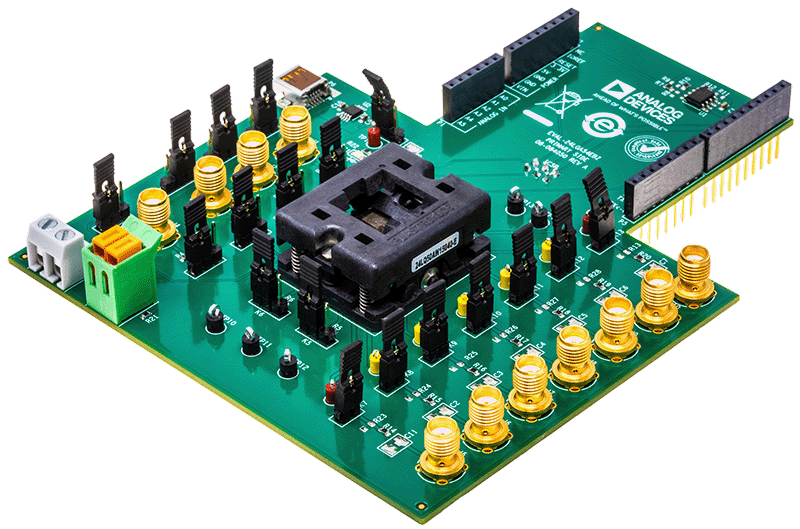
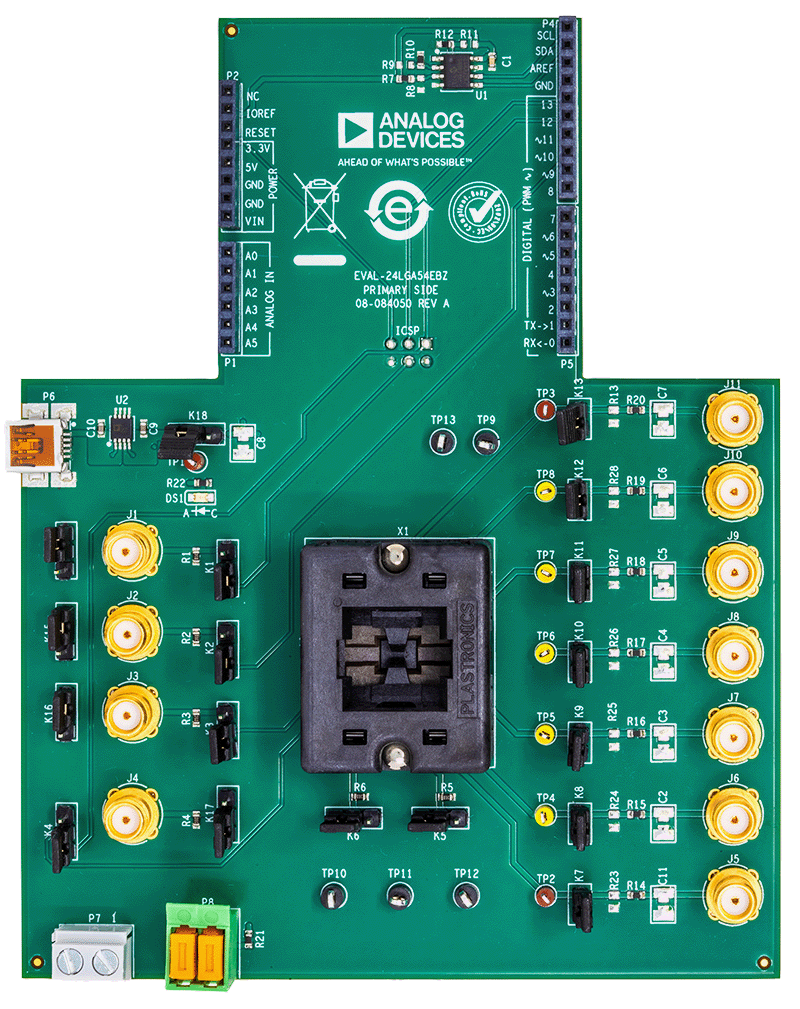
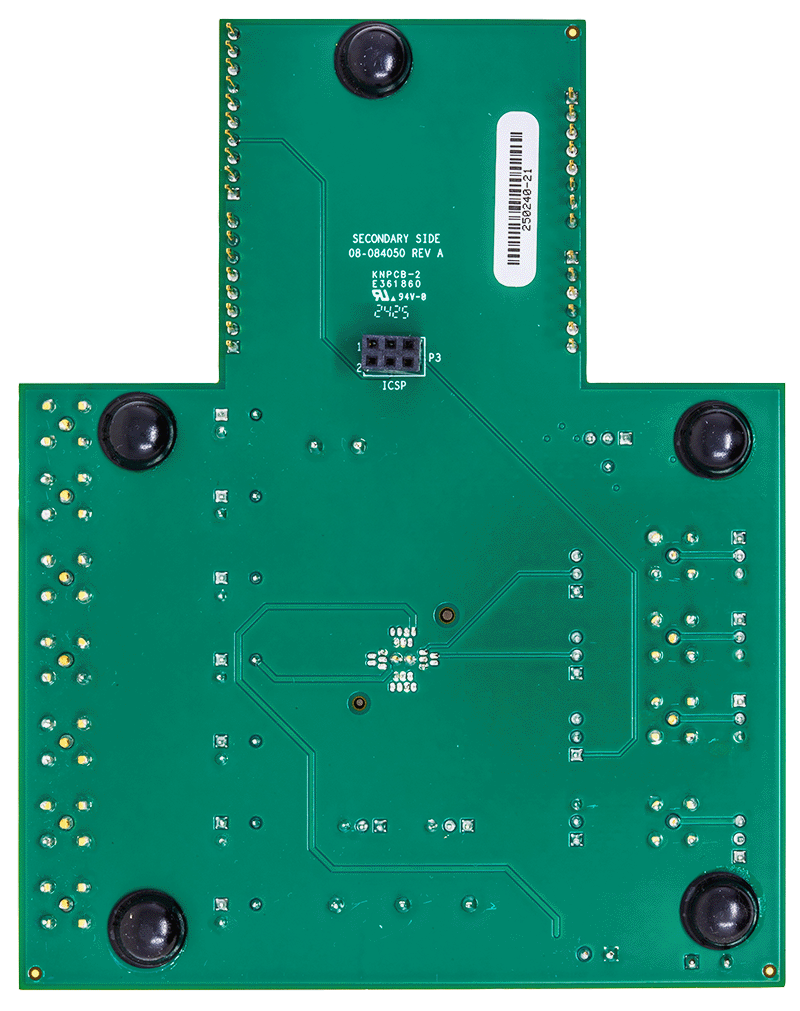
EVAL-24LGA54EBZ

Evaluation Board for the 24-Lead LGA Devices in the Switches and Multiplexers Portfolio

Features and Benefits

  • 24-lead, 5mm × 4mm LGA evaluation board for MEMS switches
  • Easily changeable socket for the main device
  • SMA connectors for the input and output of signals
  • Integrated Arduino shield support

Product Details

The EVAL-24LGA54EBZ enables easy evaluation of the 24-lead land grid array (LGA) MEMS switches in the Switches and Multiplexers Portfolio that are purchased separately. The board is supplied with a socket to secure a 24-lead LGA micro electromechanical systems (MEMS) switch to the evaluation board without the need for soldering.

Figure 1 shows the EVAL-24LGA54EBZ evaluation board. A 24 lead LGA MEMS switch can be easily inserted into the central socket of the evaluation board that is designed for flexible testing of various switch configurations. Each MEMS switch pin connects to a header (K1 to K17), allowing users to route signals, tie pins to ground, or configure the pins as needed. K7 to K13 support general input/output (I/O) or ground connections. The EVAL-24LGA54EBZ supports the following two logic control modes: parallel logic digital control using K14 to K17 or serial peripheral interface (SPI) from a connected Arduino board using K1 to K4. The logic control mode is selected through K5, where connecting it to GND enables parallel logic control mode and connecting it to VDD enables the MEMS switch SPI. The EVAL-24LGA54EBZ has Subminiature Version A (SMA) connectors (J1 to J11) that connect directly to the MEMS switch pins and are used for signal access, allowing users to easily apply or monitor control signals during testing. There are multiple power options on the board for providing power supplies to the evaluation board. A two-screw terminal connector can be used to provide VDD connection directly to the MEMS switch from an external supply or a regulated 3.3V derived from the Micro-USB connector or compatible Arduino board.

The full specifications of the device under test (DUT) are available in the corresponding product data sheet, which must be consulted with the EVAL-24LGA54EBZ user guide when using the EVAL-24LGA54EBZ.

EVAL-ADGM1004SDZ
ADGM1004SDZ Evaluation Board
ADGM1004SDZ Evaluation Board ADGM1004SDZ Evaluation Board ADGM1004SDZ Evaluation Board EVAL-ADGM1004SDZ Image
EVAL-24LGA54EBZ
Evaluation Board for the 24-Lead LGA Devices in the Switches and Multiplexers Portfolio
EVAL 24LGA54EBZ  Board Photo Angle View EVAL 24LGA54EBZ Board Photo Top View EVAL 24LGA54EBZ Board Photo Bottom View

Latest Discussions

Recently Viewed